
Types of Factoring in Business Finance: A Practical Guide
Waiting 30, 60, or 90 days for customers to pay invoices can put pressure on an otherwise healthy business. That is where factoring may help. The main types of factoring give businesses different ways to convert unpaid invoices into faster access to cash. Depending on the arrangement, the business may retain responsibility if a customer fails to pay, transfer certain credit risks to the factor, sell selected invoices, or factor most eligible receivables.
Factoring can improve short-term cash flow, but it is not free money or automatically the best financing choice. Therefore, business owners should understand how each arrangement works, what it costs, and which risks remain with the company before signing an agreement.
What Is Factoring in Business?
Factoring is a form of accounts receivable financing in which a business sells eligible invoices to a factoring company, commonly called a factor.
Instead of waiting for the customer to pay, the business receives most of the invoice value sooner. Then, depending on the arrangement, the factor collects payment from the customer. After collection, the factor pays the remaining balance to the business minus agreed fees and other applicable charges.
For example, imagine a company issues a $20,000 invoice with 60-day payment terms. Rather than waiting two months, it sells the invoice to a factor and receives an advance based on an agreed percentage of the invoice. Once the customer pays, the remaining amount is settled according to the factoring agreement.
Although factoring involves financial records, it helps to understand the difference between finance and accounting. Accounting records and reports transactions, while finance focuses more broadly on funding, cash management, investment, and financial decisions. Factoring sits mainly on the financing side while directly affecting accounting records for receivables and fees.
How Does Factoring Work?
While agreements vary, the process usually follows a straightforward sequence.
First, a business provides goods or services to an approved customer and issues an invoice. Next, the business submits that invoice to the factoring company.
The factor verifies the invoice and, if it meets the agreement’s requirements, provides an advance. The advance rate varies based on factors such as industry, customer credit quality, invoice terms, and the factoring arrangement.
Later, the customer pays according to the agreed process. Finally, the factor settles the remaining balance after deducting its fees and any other agreed amounts.
Factoring companies often pay close attention to the creditworthiness of the invoiced customers because those customers are responsible for paying the invoices.
Therefore, a small company with limited operating history may sometimes qualify when it has strong business customers with reliable payment records. Still, approval requirements vary considerably between factors.
Main Types of Factoring in Finance
The types of factoring in finance are usually distinguished by who carries certain risks, which invoices are included, whether customers know about the arrangement, and how payments are handled.
Here are the most common structures.
| Factoring type | Main feature | May suit |
|---|---|---|
| Recourse | Seller remains responsible for specified unpaid invoices | Businesses seeking potentially lower-cost factoring |
| Non-recourse | Factor assumes defined credit risk | Businesses wanting protection from specified customer credit failures |
| Whole-turnover | Most or all eligible invoices are factored | Companies with ongoing cash-flow needs |
| Spot | Individual invoices are selected | Businesses with occasional funding needs |
| Disclosed | Customer knows a factor is involved | Companies comfortable with direct factor collection |
| Confidential | Customer may not be told about the arrangement | Businesses prioritizing customer-facing continuity |
| Maturity | Payment is provided around an agreed maturity date | Businesses emphasizing receivables administration |
| Export | Designed for international receivables | Companies selling to overseas customers |
However, terminology is not perfectly standardized across providers and countries. Therefore, always read the actual contract rather than relying on the product name alone.
1. Recourse Factoring
Recourse factoring is one of the most common arrangements.
Under recourse factoring, the business remains responsible under agreed circumstances if a customer fails to pay an invoice. For example, the company may have to repurchase an unpaid invoice or replace it with another eligible receivable after a specified period.
Because the factor takes less credit risk, recourse factoring can be less expensive than comparable non-recourse arrangements.
However, the business retains meaningful risk. Therefore, companies should assess customer payment quality before deciding whether lower fees justify that exposure.
2. Non-Recourse Factoring
Non-recourse factoring shifts certain defined customer credit risks to the factor.
However, “non-recourse” does not mean the factor accepts every possible reason an invoice might go unpaid. Coverage may apply only to specific events, such as an approved customer’s insolvency.
For instance, disputed invoices, product problems, contractual disagreements, fraud, or invoices that do not meet eligibility requirements may remain the seller’s responsibility.
Consequently, businesses should examine the contract’s definition of non-recourse carefully. The broader the protection, the more valuable it may be, although fees can also be higher.
3. Whole-Turnover Factoring
Whole-turnover factoring involves an ongoing arrangement covering most or all eligible invoices within an agreed category.
For example, a manufacturer that regularly sells to business customers on 60-day terms might factor its eligible receivables each month.
This approach can create a more predictable source of working capital because funding grows alongside eligible sales.
However, the company may lose some flexibility if it must submit most qualifying invoices rather than choosing only those for which it needs faster cash.
Companies should also consider how factoring fits their supplier and purchasing relationships. Understanding What Is a Vendor can help newer business owners distinguish suppliers that provide goods or services to the company from customers whose receivables may be factored.
4. Spot Factoring
Spot factoring, sometimes called single-invoice factoring, allows a business to factor one or a small number of invoices rather than committing most receivables.
Suppose a company has enough cash during normal months but suddenly wins a large contract that requires upfront labor and materials. It could factor a substantial completed invoice to access cash sooner.
This flexibility makes spot factoring attractive for occasional needs.
However, pricing per invoice can be higher than under some ongoing arrangements. Therefore, businesses should compare the total cost rather than assuming greater flexibility is automatically cheaper.
5. Disclosed Factoring
With disclosed factoring, customers know that their invoices have been assigned to a factor.
Invoices may include instructions directing customers to send payment to the factoring company or a designated account.
This arrangement can simplify collection because the factor communicates directly with customers about payment.
Still, customer communication matters. A business should explain payment instructions clearly so legitimate changes do not create confusion or concerns about invoice fraud.
In some financial transactions, intermediaries also connect parties or facilitate deals. Business owners researching those roles may ask What Is a Broker, although a factoring company buying receivables serves a different function from a typical broker arranging transactions between other parties.
6. Confidential Factoring
Confidential factoring is structured so that customers may not be made aware of the financing arrangement, subject to the product design and applicable law.
The business may continue managing customer-facing collections while receiving funding against eligible invoices behind the scenes.
For companies that want to maintain direct control over customer relationships, this can be appealing.
However, confidential arrangements may require stronger financial controls and established collection procedures. Likewise, eligibility requirements may be stricter because the factor has less direct involvement in customer payments.
Because providers use terms differently, businesses should confirm exactly how notices, collections, and payments will operate.
7. Maturity Factoring
Maturity factoring differs from arrangements designed mainly to provide an immediate cash advance.
Under this structure, the factor may handle receivables administration and provide payment to the business around an agreed maturity date or according to the contract.
Therefore, the primary value may involve credit administration and collections rather than receiving cash immediately after issuing an invoice.
This arrangement is less relevant for a company whose main problem is an urgent working-capital shortage. However, it may suit businesses looking to streamline receivables management.
8. Export Factoring
Export factoring is designed for businesses selling goods or services to customers in other countries.
International receivables can introduce extra challenges, including unfamiliar credit markets, longer payment cycles, currencies, documentation, and different legal systems.
An export factoring arrangement may help with financing and collections while providing credit-management support, depending on the provider.
Still, international transactions can be complex. Therefore, businesses should understand currency exposure, fees, legal jurisdiction, customer coverage, and any country-specific restrictions before proceeding.
The broader purchasing side of a company’s operations can be equally complex, which is why understanding What Is Procurement helps business owners see how purchasing, supplier management, working capital, and receivables can affect one another.
Different Types of Factoring: Recourse vs Non-Recourse
Among the different types of factoring, the recourse versus non-recourse decision deserves particular attention.
With recourse factoring, the business generally carries more of the risk if an eligible customer does not pay under circumstances defined by the agreement. In return, costs may be lower.
With non-recourse factoring, the factor accepts certain specified credit risks. However, protection is limited by the contract and usually does not cover every type of nonpayment.
Therefore, ask three questions before choosing:
- Exactly which events does the factor cover?
- What happens when a customer disputes an invoice?
- What must the business do if an invoice remains unpaid?
Clear answers make the real difference between the two structures much easier to evaluate.
Advantages of Factoring
Faster access to cash is the most obvious benefit. Instead of waiting for invoice due dates, businesses can use eligible receivables to support near-term cash flow.
Factoring may also help companies fund payroll, purchase materials, accept new orders, or manage seasonal growth.
Another potential advantage is that qualification can depend significantly on customer credit quality rather than solely on the seller’s traditional borrowing profile.
Depending on the arrangement, factors may also provide receivables administration and collection services.
Still, every benefit should be compared with the cost and contractual obligations.
Disadvantages and Risks
Factoring fees reduce the amount the business ultimately keeps from its invoices. Therefore, frequent use can become expensive.
Customer relationships can also be affected when a factor handles collections. Poor communication or aggressive collection practices may reflect badly on the business.
Likewise, recourse arrangements can leave the company responsible for unpaid invoices even after it has received an advance.
Contracts may also include minimum volumes, concentration limits, termination provisions, service charges, or other conditions. As a result, comparing only the headline factoring rate can give an incomplete picture.
How to Choose the Right Type of Factoring
Start by identifying why the business needs factoring.
If funding is required only occasionally, spot factoring may provide useful flexibility. In contrast, a company with continuous working-capital needs might prefer an ongoing arrangement.
Next, review customer quality. Businesses with reliable customers may be comfortable retaining more risk through recourse factoring.
Then, calculate the full cost. Review factoring fees, service charges, minimum requirements, advance rates, contract length, and termination conditions.
You should also consider customer experience. If preserving direct control of collections is a priority, explore arrangements that support that goal.
Finally, compare factoring with alternatives such as a business line of credit, conventional loan, invoice financing, or improved internal collection processes.
Types of Factoring in Math vs Business Factoring
The phrase types of factoring in math refers to a completely different subject.
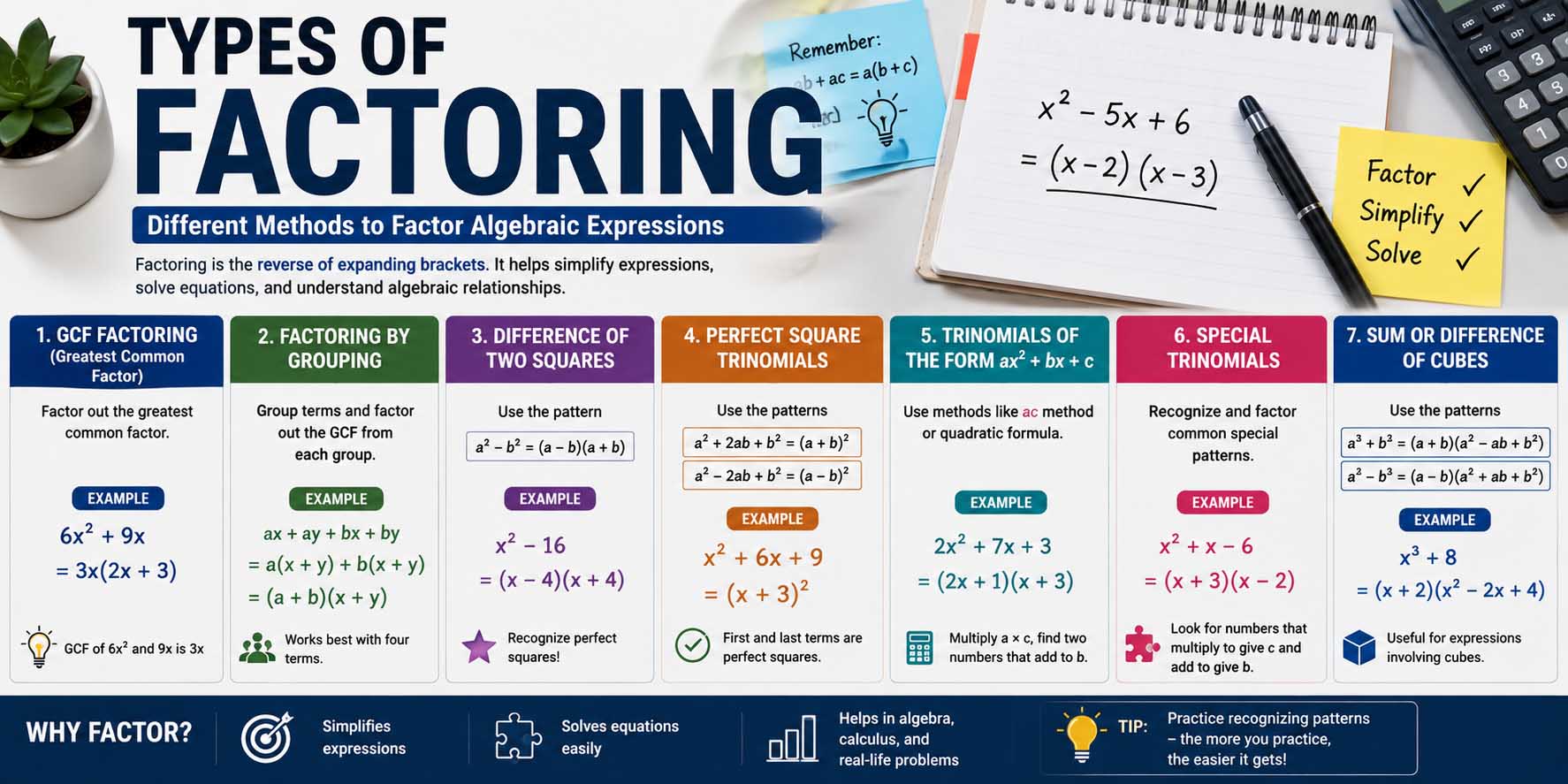
In mathematics, factoring means rewriting an expression as a product of simpler factors. Students might use techniques such as finding a greatest common factor, factoring trinomials, grouping, or recognizing a difference of squares.
Business factoring, by contrast, involves accounts receivable and financing.
Therefore, someone searching for all types of factoring should first determine whether they need mathematical factoring methods or financial factoring arrangements. This article focuses specifically on business finance.
Frequently Asked Questions
What is the most common type of factoring?
Recourse factoring is widely used because the business retains specified nonpayment risks, which can make the arrangement less costly than comparable non-recourse factoring. However, availability varies by provider and industry.
Is factoring the same as a business loan?
No. Traditional factoring generally involves selling eligible accounts receivable rather than borrowing money through a conventional loan. Still, contracts differ, so businesses should understand the legal and accounting treatment of their specific arrangement.
Is factoring only for struggling businesses?
No. Growing businesses may use factoring because rapid sales growth can create cash-flow pressure when customers pay weeks after receiving goods or services.
Does factoring affect customers?
It can. In disclosed factoring, customers may receive new payment instructions and communicate with the factor about invoices. Therefore, professional communication and collection practices matter.
How much does factoring cost?
Costs vary based on invoice volume, customer credit quality, industry, payment terms, risk allocation, and contract structure. Therefore, businesses should request a complete fee schedule and calculate the expected total cost under realistic payment timelines.
Is non-recourse factoring risk-free?
No. Non-recourse agreements usually cover specific credit risks rather than every possible cause of nonpayment. Businesses should review exclusions and dispute provisions carefully.
Choosing Factoring With Cash Flow in Mind
Understanding the types of factoring makes it easier to match financing with a company’s actual cash-flow needs. Recourse factoring may offer lower costs while leaving more risk with the seller, whereas non-recourse arrangements can transfer certain defined credit risks. Meanwhile, spot, whole-turnover, disclosed, confidential, maturity, and export factoring solve different operational problems.
Before signing an agreement, calculate the complete cost, review what happens when customers pay late or dispute invoices, and understand every obligation placed on your business. Then compare factoring with other financing options. The best choice is the one that improves working capital without creating costs, risks, or customer-service problems that outweigh the cash-flow benefit.